Finding a 20-year-old bottle can feel like opening a time capsule. The good news is that age alone does not make wine unsafe to drink. The more complicated question is whether the wine will still be pleasurable. Its condition depends on the original quality, grape variety, winemaking style, closure, and—most importantly—how the bottle was stored. A mature wine may offer extraordinary complexity, but it may also be faded, oxidized, or simply past its best.
Twenty Years Old Does Not Automatically Mean Better
Wine changes in bottle, but only certain wines are built to improve for two decades. Many everyday wines are deliberately made for fresh fruit, softness, and early drinking. With time, their aromas can disappear before compelling mature flavors develop. Age-worthy wines usually begin with a useful balance of acidity, flavor concentration, and structural components such as tannin or sugar. These do not preserve wine indefinitely, but they can help it evolve slowly rather than collapse quickly.
Which Wines Are Most Likely to Survive?
Classic candidates include structured Cabernet Sauvignon, Nebbiolo, Syrah, traditional Tempranillo, vintage Port, and high-quality red Bordeaux blends. Among white wines, top Riesling, Chenin Blanc, white Burgundy, Sauternes, and certain traditional-style Champagnes can mature beautifully. Sweetness, acidity, tannin, alcohol, and concentration may each contribute to longevity, although no single feature guarantees it. Fortified wines can be especially durable, while Madeira is unusually resilient because heat and controlled oxidation are part of its production.
A wine cellar does not create greatness; it preserves the potential that was present when the bottle was made.Producer, vineyard, vintage, and bottle format matter as much as grape variety. A serious wine from a difficult vintage may age less successfully than a balanced bottle from a favorable year. Magnums often develop more slowly because they contain proportionally less oxygen relative to the volume of wine.
Storage Is the Decisive Factor
A modest wine stored well can outlive a prestigious bottle kept badly. Long-term storage should be cool, dark, and stable, commonly around 10–15°C. Repeated temperature swings are particularly undesirable because heat accelerates chemical reactions and may encourage leakage around the closure. Direct sunlight and strong artificial light can also damage wine. Bottles sealed with natural cork have traditionally been stored horizontally, helping maintain contact between wine and cork, while screw-cap bottles do not require this position.
Provenance is therefore invaluable. A bottle kept for 20 years in a temperature-controlled cellar is a different proposition from one displayed above a warm kitchen cabinet. If its history is unknown, approach it with curiosity rather than expectation.
Inspect the Bottle Before Opening
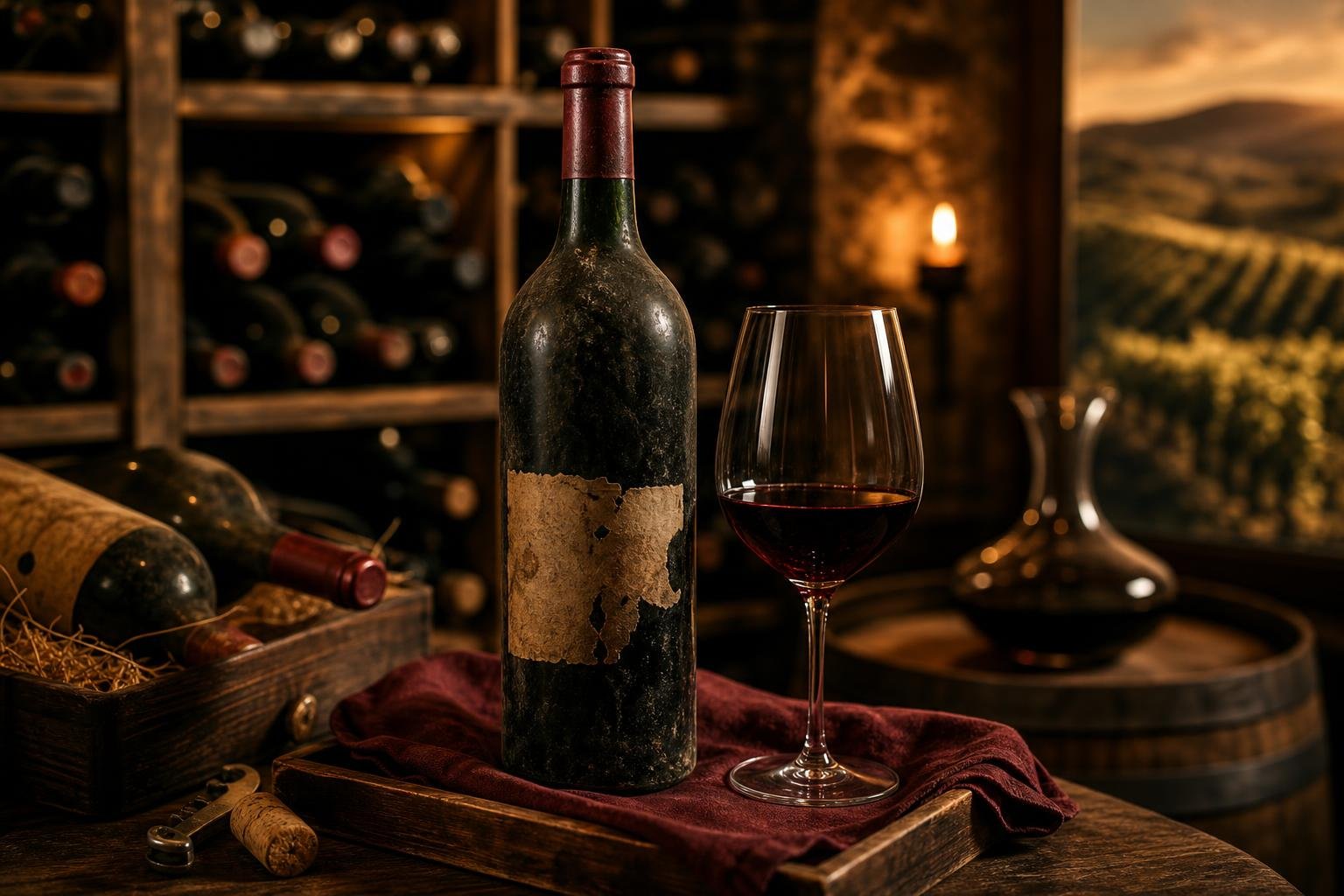
Look for seepage, sticky residue, a protruding cork, or a capsule stained by wine. These signs may indicate heat exposure or closure failure, although minor staining does not always mean the wine is ruined. Examine the fill level, known as ullage. Some loss is natural over decades, but an unusually low level suggests substantial evaporation or oxygen ingress. Bottle shape affects how ullage is described, so comparisons should be made with similar bottles.
Cloudiness is not necessarily a fault. Mature red wine commonly deposits harmless sediment made from pigments and tannins, while crystalline tartrates may appear in either red or white wine. Neither makes the wine unsafe.
How to Open a Mature Bottle
Stand the bottle upright for at least several hours, and preferably a day, so sediment can settle. Remove the capsule and clean the neck before drawing the cork. Old corks can become fragile; a two-pronged opener, often called an Ah-So, can be more effective than an ordinary corkscrew. A Durand-style tool combines prongs with a screw and is particularly useful for valuable mature bottles.
Pour slowly under good light and stop when sediment approaches the neck. Decanting is a judgment call. It separates clear wine from sediment, but prolonged aeration can quickly exhaust a delicate old bottle. Taste first. A robust mature Cabernet may open with air, whereas an elderly Pinot Noir can lose its perfume within minutes.
How to Tell Whether It Is Still Good
Oxidized wine may smell of bruised apple, nuts, caramel, or stale cider and appear unusually brown. Some oxidative notes are normal in particular styles, but lifeless fruit and a flat finish indicate decline. Cork taint, usually associated with TCA, produces damp-cardboard or musty-cellar aromas; it is a closure fault, not a consequence of age itself. Strong vinegar, nail-polish-remover, rotten, or persistently moldy odors are further reasons to reject the wine.
A mature color is not proof of spoilage. Red wines often move from purple and ruby toward garnet or tawny shades, while whites deepen from pale straw toward gold and amber. Aroma and flavor provide better evidence than color alone.
Is Old Wine Safe to Drink?
Properly sealed old wine is generally not hazardous merely because it is old. Wine’s alcohol, acidity, and other conditions discourage common foodborne pathogens. Spoilage is therefore more often a quality problem than a safety problem. Nevertheless, discard a bottle if it shows evidence of foreign contamination, broken glass, severe leakage, or an unknown substance. When the bottle appears sound but the wine seems tired, a small taste will usually settle the question.
The Final Verdict
Yes, you can still drink a 20-year-old bottle of wine, but age is a possibility, not a promise. Check the style, provenance, fill level, and closure; open it gently; and let the glass deliver the verdict. Even a faded bottle can be fascinating, offering a brief sensory record of a vineyard, vintage, and moment that cannot be recreated.