Valuing old Bordeaux requires more than identifying a famous château and vintage. Two bottles bearing the same label can command markedly different prices because storage, provenance, fill level, format, and authenticity all influence buyer confidence. Moreover, financial value should not be confused with drinking quality: a mature lesser-known wine may provide a lovely experience while having little auction demand, whereas a prestigious but fragile bottle may remain collectible despite uncertain drinkability.
Establish the Bottle's Exact Identity
Begin with the château, appellation, vintage, bottle size, and number of bottles available. Confirm whether the wine is the estate's grand vin or a second label. Château Margaux and Pavillon Rouge du Château Margaux, for example, are distinct wines with different market histories. Also note whether the bottle is a standard 750 millilitres, a half-bottle, or a larger format such as a magnum. Magnums often mature more slowly because they contain proportionally less oxygen relative to the volume of wine, although their market is narrower and shipping is more complicated.
Understand Classification Without Relying on It Alone
Bordeaux classifications provide context, not an automatic valuation. The 1855 Classification ranked leading Médoc estates and Château Haut-Brion, then associated with Graves, for the Paris Exposition; it also classified the sweet wines of Sauternes and Barsac separately. Château Mouton Rothschild's promotion from Second to First Growth in 1973 remains the classification's only formal change in rank. Pomerol, home to celebrated estates such as Pétrus, has no official classification, while Saint-Émilion uses a separate system that has been revised over time. Reputation, scarcity, critical standing, and demand can therefore matter as much as formal rank.
Assess the Vintage in Its Proper Context
A celebrated vintage can substantially increase value, but vintage reputation must be considered at château and appellation level. Weather does not affect every part of Bordeaux identically, and estates differ in vineyard sites, harvest decisions, and selection standards. Years such as 1945, 1961, 1982, 1990, 2000, 2005, 2009, and 2010 are widely admired, yet this does not mean every wine from those years is equally successful. Consult several professional vintage assessments rather than depending on a single score.
A famous vintage opens the conversation; the individual bottle decides the price.Inspect Fill Level and Physical Condition
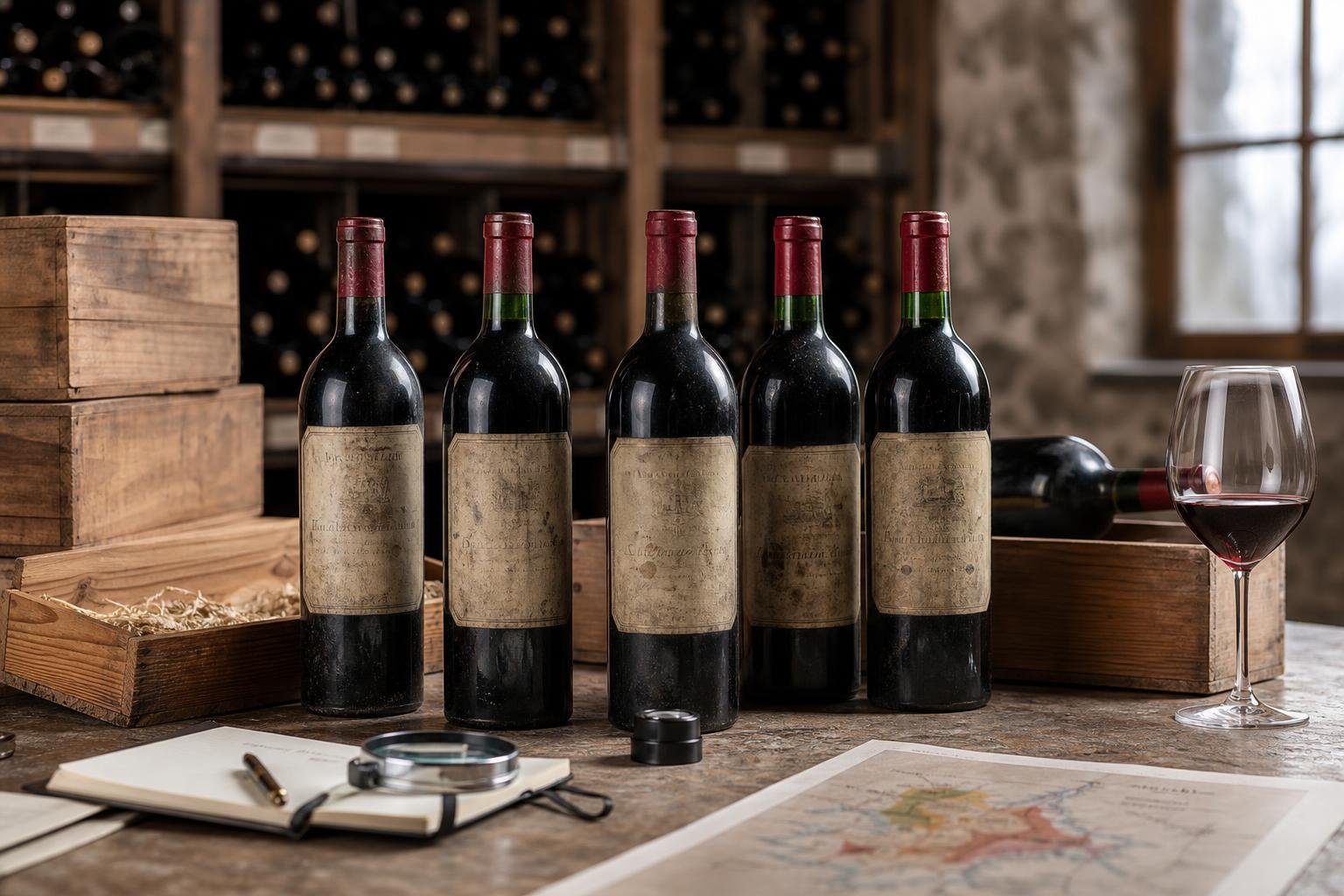
For mature Bordeaux, the wine level inside the bottle is one of the strongest visible indicators of condition. Auction catalogues commonly describe levels as into neck, base neck, top shoulder, upper shoulder, mid shoulder, or lower. Some ullage, the air space above the wine, is normal as a bottle ages. A markedly low level, however, may indicate evaporation, a failing cork, or poor storage, all of which increase the risk of oxidation.
Examine the capsule for corrosion, seepage, or signs that wine has pushed past the cork. A raised cork or sticky capsule can suggest heat exposure. Labels matter commercially, particularly to collectors, but a stained or torn label does not necessarily mean the wine itself is unsound. Conversely, a pristine label cannot prove good storage. Photograph the fill level, label, capsule, bottle base, and any case markings in neutral light.
Investigate Provenance and Storage
Provenance is the documented chain of ownership and storage. A bottle bought on release, kept in a professionally managed cellar, and supported by invoices will usually inspire more confidence than an unexplained bottle found in an attic. Stable, cool, dark, and vibration-free storage is preferable; repeated temperature fluctuations can accelerate deterioration. Original wooden cases may add desirability, especially when the bottles have remained together since release.
Some old bottles have been recorked at the château. Documented recorking can reassure buyers about authenticity and maintenance, although collectors may differ over whether intervention affects originality. Never replace a capsule, clean a label aggressively, or open a bottle merely to inspect the cork before seeking expert advice.
Check Authenticity Carefully
Prestigious Bordeaux is a target for counterfeiting. Authenticity assessment may involve the label's paper and printing, capsule construction, glass shape, cork branding, vintage markings, and ownership history. No single feature is conclusive because packaging changed over decades and estates sometimes used more than one supplier. Suspiciously new labels, historically incorrect materials, inconsistent bottle wear, or a vague story attached to an exceptional rarity are warning signs. High-value bottles should be examined by an experienced auction specialist or authenticator rather than judged from online photographs alone.
Use Comparable Sales, Not Asking Prices
Search recent results for the same château, vintage, format, condition, and provenance. A retailer's advertised price is not proof of market value; completed auction sales reveal what buyers actually paid. Distinguish the hammer price from the buyer's total cost, which may include an auction premium and taxes. Likewise, a seller's net proceeds will be reduced by commission, insurance, and transport.
Single bottles often sell differently from full cases. Markets also vary by location, and demand can change with critic reassessments, economic conditions, and the wine's perceived drinking window. Several comparable sales are more informative than one unusually high result.
Obtain a Professional Valuation
For an important bottle or cellar, request estimates from more than one established wine auction house, merchant, or specialist appraiser. Provide a complete inventory and clear photographs, together with purchase records and storage details. Ask whether the estimate represents auction value, retail replacement value, insurance value, or expected net proceeds; these figures serve different purposes. Ultimately, old Bordeaux is valued through evidence. Pedigree creates potential, but condition, provenance, authenticity, and real buyer demand determine how much of that potential survives in the bottle.