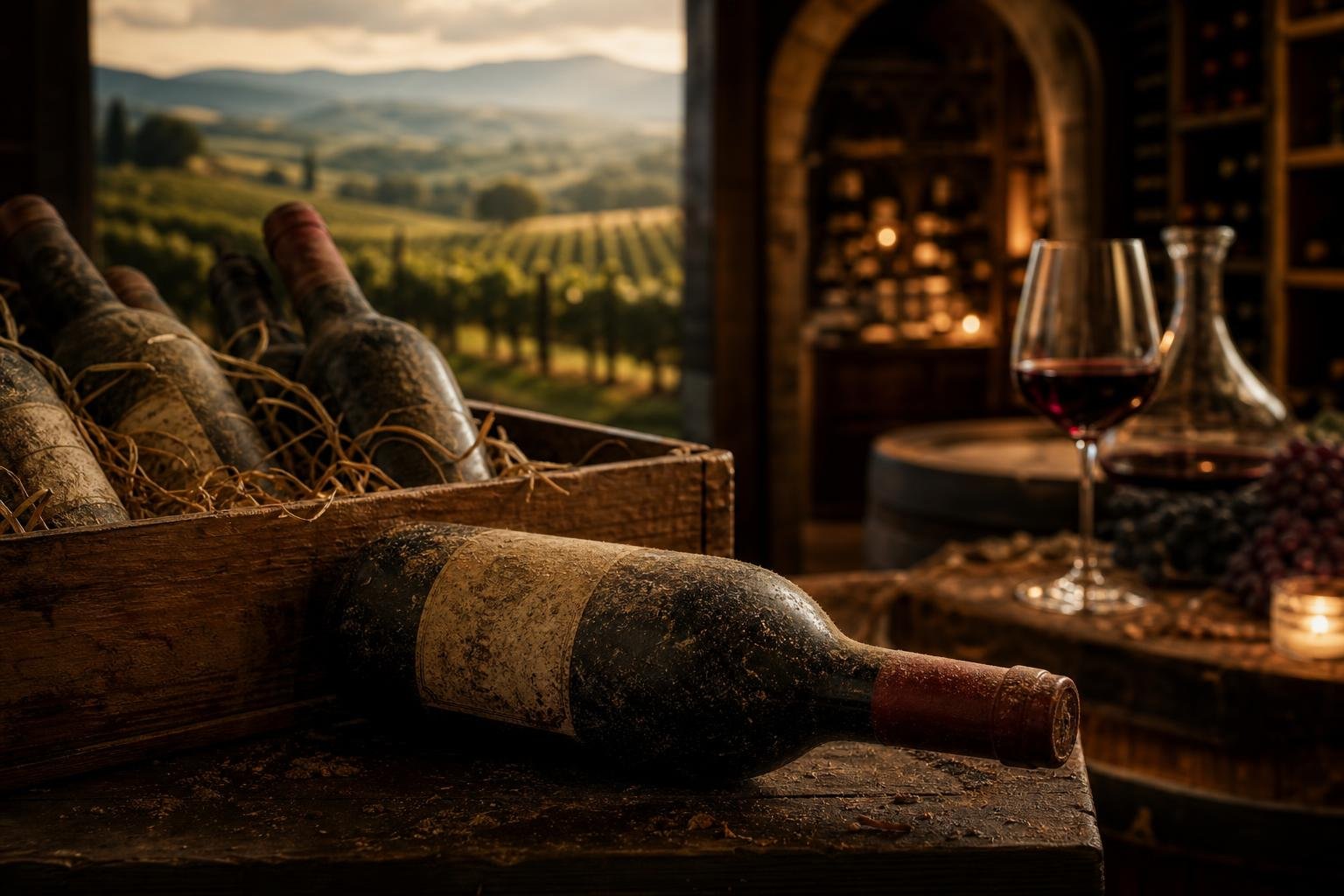
Finding a dust-covered bottle in a cellar, attic, or inherited cabinet can inspire visions of a small fortune. Occasionally, that hope is justified. Yet age and dust are not reliable measures of value. Most old bottles are worth little on the secondary market, while a narrow group of well-preserved wines from celebrated producers and vintages can command serious attention. The difference lies in identity, condition, provenance, and demand.
Age Alone Does Not Make Wine Valuable
Wine is not automatically improved by decades in bottle. Most wines are made for drinking within a few years, and even age-worthy examples eventually decline. Collectors generally pursue specific names: leading Bordeaux châteaux, prestigious Burgundy domaines, renowned Barolo and Barbaresco producers, vintage Port houses, top Rhône estates, and certain cult or historically important wines from California and elsewhere.
The vintage shown on a label normally identifies the year in which the grapes were harvested, not necessarily the year of bottling. It matters because weather and growing conditions affect quality, quantity, and reputation. However, an acclaimed vintage from an obscure producer may still have limited demand, while a famous producer can attract buyers even in a less celebrated year.
In the fine-wine market, an old bottle is valuable not because it survived, but because buyers want that particular wine and trust how it survived.Begin with the Producer and Exact Wine
Read every part of the label, including the producer, vineyard or cuvée, appellation, vintage, alcohol level, importer, and bottle size. Similar-looking labels can represent very different wines. In Burgundy, for example, a village wine, premier cru, and grand cru from the same producer may occupy entirely different price brackets. In Bordeaux, the château name is often more commercially significant than age alone.
Check recent auction results rather than optimistic retail listings. A merchant’s asking price is not proof that a bottle sells at that level. Auction databases, specialist retailers, and established wine auction houses provide better evidence, although prices vary by bottle condition, location, taxes, commissions, and lot size. A single bottle may also be less attractive than an unopened original case.
Storage History Is Critical
Provenance means the documented history of ownership and storage. Buyers prefer bottles that have remained in a cool, dark, stable cellar, ideally with records showing where and when they were purchased. Long exposure to attic heat, sunlight, repeated temperature swings, or vibration can damage wine even when the bottle still looks impressive.
Traditional cellars commonly maintain temperatures around 10–15°C, with sufficient humidity to reduce cork shrinkage without encouraging destructive mold. Exact conditions vary, but stability is crucial. A bottle discovered beside a boiler or under a hot roof should be treated cautiously. Dust may suggest neglect, yet it proves neither age nor good storage.
Inspect the Fill Level and Closure
The fill level, often called ullage, is among the clearest visible clues to condition. Some evaporation is normal over many decades, but an unusually low level can indicate leakage, cork failure, or poor storage. On Bordeaux-shaped bottles, auction descriptions may refer to levels such as base neck, top shoulder, or mid shoulder. Burgundy bottles have sloping shoulders, so the distance between the cork and wine is often measured in centimetres.
Look for seepage, a pushed or sunken cork, wine-stained capsules, cracks, and signs of heat damage. A corroded capsule is not always fatal, particularly in a humid cellar, but active leakage is concerning. Do not remove the capsule to investigate: doing so may damage evidence of authenticity and reduce marketability.
Labels, Capsules, and Authenticity Matter
A stained or torn label can lower value because collectors care about presentation as well as liquid condition. More importantly, the label, capsule, cork branding, glass, and printing should be consistent with the claimed bottling period. Fine-wine counterfeiting is a genuine risk, especially for famous and expensive bottles. Serious auction houses may examine typography, paper, bottle shape, sediment, and closure details before accepting a consignment.
Resist the urge to wash or polish the bottle. Gently remove loose surface dust only if an appraiser advises it, and never soak the label. Photograph the bottle upright in natural, indirect light, capturing the front and back labels, capsule, fill level, base, and any case markings.
Some Wines Survive Better Than Others
Wines with high acidity, substantial tannin, concentrated fruit, sweetness, or fortification often have greater aging potential. Vintage Port, Madeira, Sauternes, Tokaji, structured Cabernet Sauvignon, Nebbiolo, and certain Rieslings can evolve for decades when well stored. Madeira is particularly resilient because its production involves controlled exposure to heat and oxygen. Nevertheless, category alone is no guarantee: producer, vintage, bottling, and condition remain decisive.
How to Obtain a Realistic Valuation
Keep the bottle unopened and store it cool, dark, and undisturbed. Record its dimensions, fill level, provenance, and any original packaging. Then contact a reputable specialist auction house, established wine merchant, or qualified appraiser. Provide clear photographs and an honest account of storage. Local alcohol laws may restrict private sales or shipment, so professional guidance is important.
Finally, distinguish financial value from drinking and sentimental value. A bottle with little auction demand may still be meaningful at a family dinner, although an old wine can be fragile or already faded. If the bottle is opened, stand it upright beforehand to settle sediment and approach decanting cautiously. The most satisfying discovery is not always a valuable trophy; sometimes it is a well-kept piece of history that still has a story to tell.