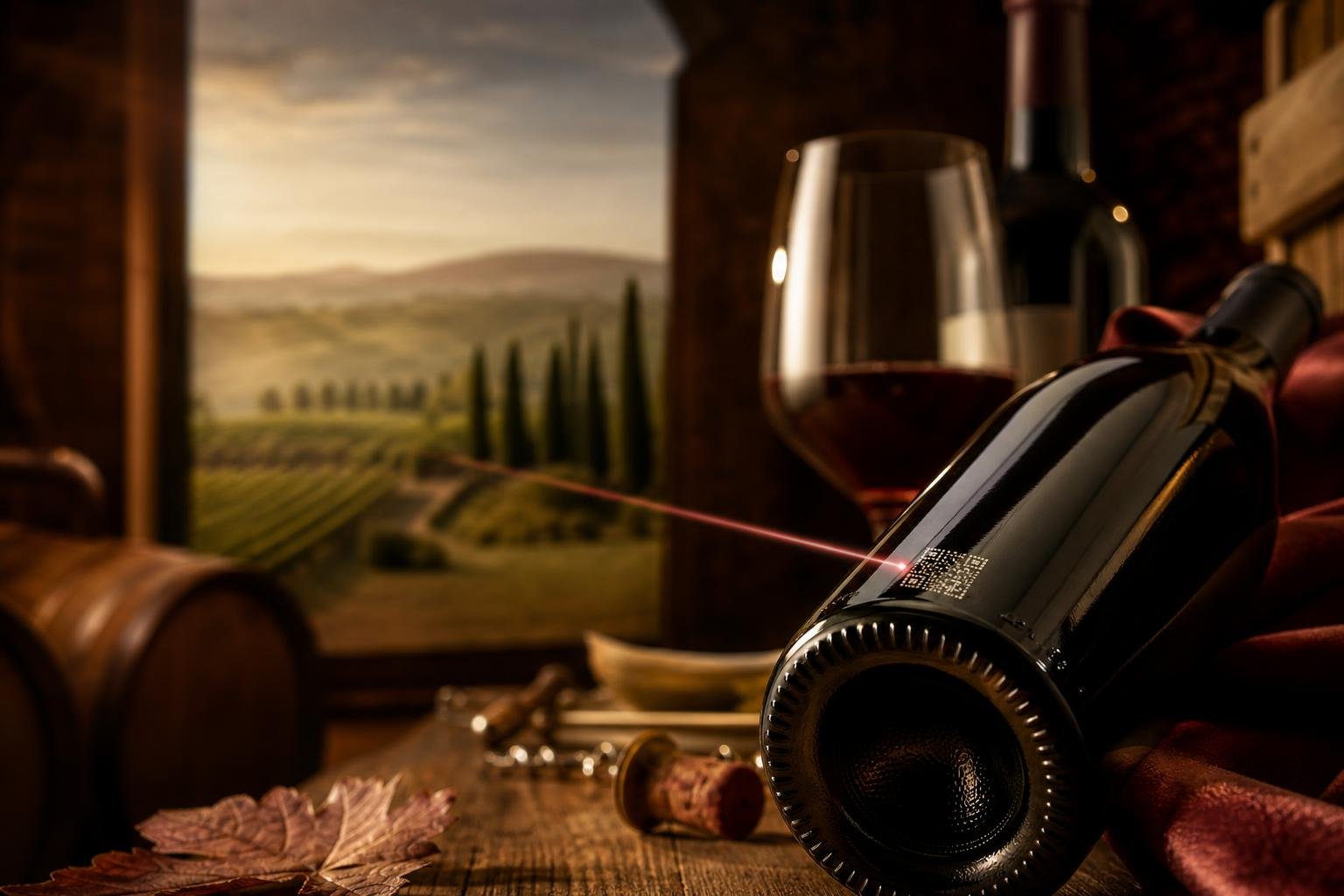
A small laser code on a wine bottle can look like a secret message: a row of letters and numbers etched onto the glass, often near the heel or along the lower edge of the label. In most cases, it is a traceability code rather than information about the wine’s vintage, quality, maturity, or drinking window. It helps a winery, bottler, distributor, or glass manufacturer identify when and where a particular production unit was made.
Most Laser Codes Identify a Production Lot
The most common interpretation is a lot or batch number. A winery may use it to connect the finished bottle with internal records covering the bottling date, production line, filling time, wine tank, packaging materials, and quality-control checks. If a problem is later discovered—such as a faulty closure, incorrect label, or unstable batch—the code helps the producer investigate and isolate the affected bottles.
There is no universal format shared by the wine industry. One producer might use a code beginning with the letter L, followed by a year and day number. Another may encode the bottling facility, line, shift, and minute of production. Without the producer’s decoding key, a sequence such as L24156 cannot be interpreted with certainty.
The code is primarily an operational fingerprint, not a consumer-facing tasting note.Why Some Codes Begin With L
In the European Union, lot identification is governed by Directive 2011/91/EU. It defines a lot as a batch of sales units produced, manufactured, or packaged under practically identical conditions. The lot indication is generally preceded by the letter L unless it is already clearly distinguishable from the other information on the package.
This explains why many European bottles carry an L-code, although the characters following it remain producer-specific. Other markets and bottlers use different systems, and a bottle without a visible L may still have a valid traceability mark printed elsewhere on the label, closure, carton, or glass.
Is It the Bottling Date?
Sometimes—but not in a format that consumers should decode by assumption. Producers frequently build a bottling date into the lot code. A three-digit section may represent the ordinal or Julian-style day of the year, with 001 meaning January 1 and 365 meaning December 31 in a non-leap year. Yet the same digits could represent a line, tank, shift, or internal job number.
Even when the date can be identified, it is the date of bottling or packaging, not the grape harvest. The vintage printed on a wine label refers to the harvest year of the grapes, subject to the labeling rules of the wine’s market and appellation. A 2020 vintage may have been bottled in 2021, 2022, or later, particularly if it received extended maturation in barrel or tank.
It Is Not Usually an Expiration Date
Still wine rarely carries a conventional expiration date because wine does not age like fresh food. Its development depends on grape variety, acidity, tannin, sugar, alcohol, winemaking, closure, and storage. A laser code therefore cannot tell you whether a bottle is still enjoyable.
To assess condition, consider provenance, storage temperature, fill level, closure integrity, seepage, and the style’s expected longevity. A young, inexpensive white wine may be designed for early drinking, while a structured Barolo or vintage Port can evolve for decades. The production code alone does not settle that question.
Could the Code Come From the Glass Factory?
Yes. Not every code on a bottle was applied by the winery. Glass manufacturers use mold, cavity, plant, and production identifiers to monitor bottle manufacturing. These marks often appear as embossed numbers, dots, symbols, or shallow characters around the base. Modern plants may also use machine-readable or laser-applied identifiers.
A bottling code is more likely to be added after the bottle reaches the filling line and may appear as sharply printed inkjet characters or a pale laser mark. Location offers clues, but it is not proof. Embossed symbols formed as part of the glass generally concern the container; a separately printed or etched alphanumeric string more often concerns packaging or filling.
Special Cases: Sparkling Wine and Disgorgement
On traditional-method sparkling wine, consumers sometimes hope a code reveals the disgorgement date—the point when spent yeast sediment is removed after ageing on the lees. That date can be useful because disgorgement begins a new phase in the wine’s development.
Some Champagne and sparkling-wine producers print the disgorgement date openly, while others provide a code that can be checked through the producer. A generic laser code should not automatically be treated as a disgorgement date; it may simply identify the bottling, labeling, or packaging run.
How to Decode a Bottle Correctly
First, record the complete code, including spaces, punctuation, and its position on the bottle. Then check the producer’s website or technical information. If no key is published, contact the winery or importer and provide the wine name, vintage, bottle size, and photographs of the code and label.
For collectors, keeping the code with purchase invoices and storage records can strengthen provenance. For everyday drinkers, its practical value is simpler: it allows the producer to trace the bottle accurately if there is a quality concern. The laser code may look cryptic, but its real purpose is accountability from production line to cellar.