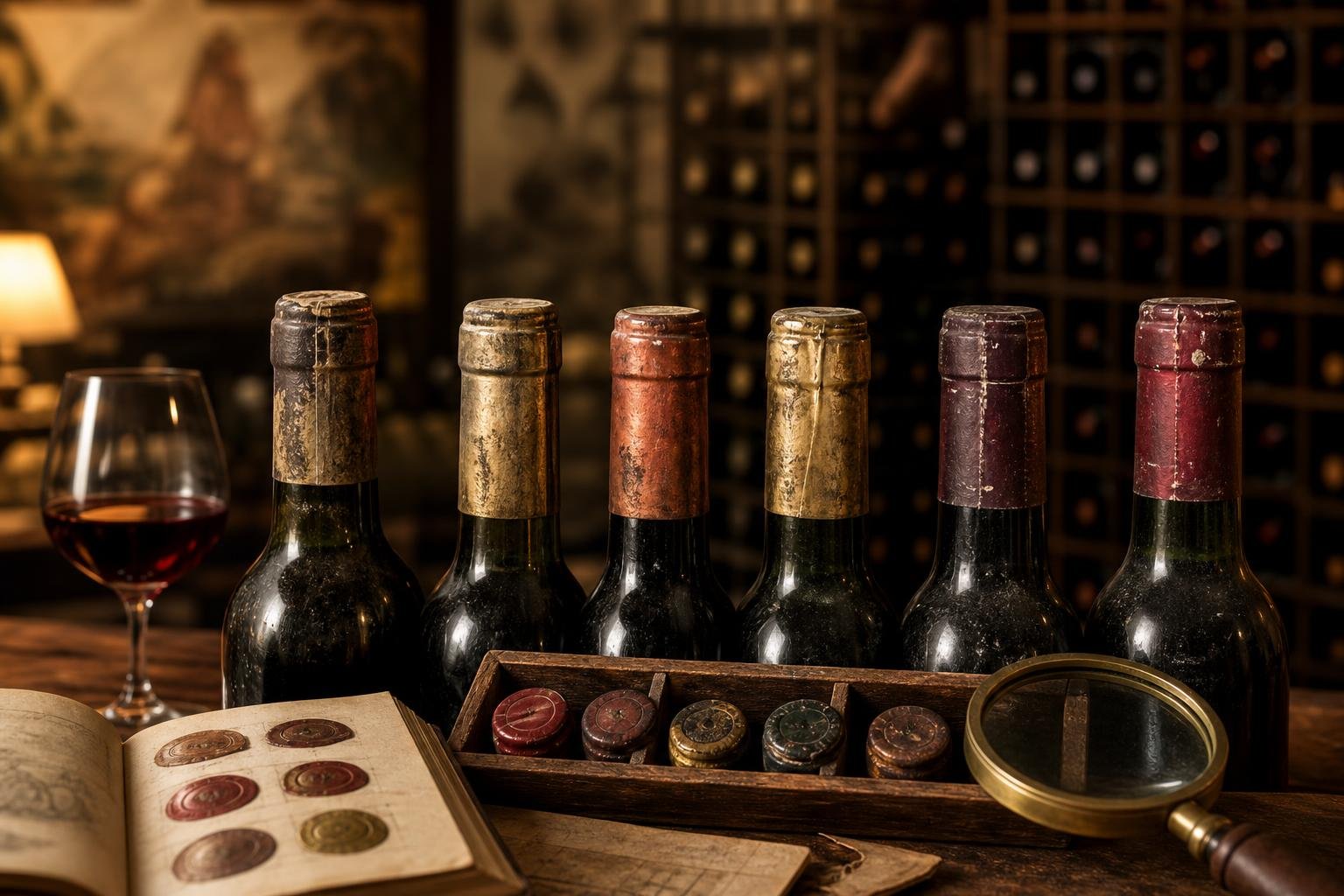
On an old bottle, the capsule is more than decoration. This fitted covering over the cork and neck—often casually called the foil—can preserve evidence about when, where and how a wine was bottled. Its material, construction, typography and condition may support an attribution or expose an obvious inconsistency. Yet capsules are only one part of authentication. Because they can be copied, replaced or manipulated, their clues must be assessed alongside the glass, label, cork, fill level and documented provenance.
Why capsules were originally used
Wine capsules developed primarily as protective and presentational coverings. They helped shield the cork and bottle lip from dust, insects and cellar grime while giving producers space for crests, names and other identifying marks. Historically, capsules were made from materials including wax, lead, tin and, more recently, aluminium, plastic laminates and heat-shrink polymers.
Lead was once valued because it was soft, dense and easy to form around a bottle neck. Health and environmental concerns led the wine trade to phase it out during the late twentieth century. Tin and aluminium became common metallic alternatives, while many everyday wines adopted plastic capsules. These broad transitions provide useful context, although they are not precise dating tools: adoption varied by country, estate, market and bottling line.
Material can reveal an anachronism
An authenticator first asks whether the capsule material is plausible for the claimed wine and period. A supposedly nineteenth-century bottle wearing a pristine modern heat-shrink capsule would demand an explanation. Conversely, heavy oxidised metal or old sealing wax may be consistent with age, but neither proves it. Fraudsters can salvage genuine capsules, artificially distress newer ones or transplant old components onto different bottles.
Material should therefore be examined in context. Metallic capsules can show characteristic folding, stiffness, oxidation and seam construction. Wax may display age-related brittleness, chips and embedded cellar dust. Plastic tends to shrink and split differently. None of these effects follows a universal schedule because humidity, temperature, handling and storage position strongly influence deterioration.
A capsule can establish consistency, but consistency is not the same as authenticity.Printing, embossing and producer details
Capsules may carry an estate name, merchant mark, crown, coat of arms, logo or vintage. Specialists compare these details with securely provenanced bottles from the same producer and era. Changes in typeface, spelling, crest design, colour, embossing depth or printing technique can narrow the likely bottling period.
Small production details are often especially revealing. Is the design centred in the same way as known examples? Does the top carry the correct emblem? Are accents and punctuation accurate? Does the capsule belong to an château-bottled release, an importer or a merchant bottling? Older European wines were not always bottled at the estate, so a merchant capsule may be entirely legitimate. Authentication requires historical knowledge rather than a simple expectation that every component should bear the producer’s name.
Seams and fitting tell a manufacturing story
The way a capsule was formed and applied can be as informative as its artwork. Experts inspect vertical seams, folds beneath the neck ring, crimping, adhesive residue and the shape of the capsule’s top. Hand-applied capsules may sit less uniformly than modern machine-fitted examples. A seam or finish associated with later equipment can conflict with an alleged bottling date.
Fit also matters. A capsule that appears too loose, unusually short or disturbed around the cork may have been removed and replaced. Scratches under an otherwise clean edge, mismatched grime or fresh adhesive can suggest intervention. However, damage may have innocent causes, including corrosion, transport, inspection or professional recorking.
Age, wear and the danger of theatrical patina
Authentic cellar wear is rarely uniform. Dust settles in recesses, oxidation develops where moisture reaches metal, and handling polishes exposed surfaces. A bottle may have a stained label but a relatively sound capsule, or the reverse. Suspicious examples sometimes look too deliberately old, with evenly distributed dirt, dramatic corrosion or wear that does not correspond to the bottle beneath it.
Condition must match the bottle’s reported history. A dry-cellared bottle should not necessarily resemble one kept for decades in a damp underground cellar. Likewise, a clean capsule is not automatically false: bottles stored in original wooden cases can remain remarkably well preserved. The most persuasive patina is physically coherent, not merely picturesque.
Recorking does not automatically indicate fraud
Long-lived wines may be professionally recorked when their corks deteriorate or fill levels decline. Some estates have historically offered recorking services, sometimes adding a new cork, capsule or identifying mark. Such work can preserve a wine, but it changes original evidence and should be supported by documentation.
A replacement capsule is therefore not necessarily deceptive. The crucial question is whether the intervention was disclosed and can be traced. An old wine with a documented estate recorking may inspire more confidence than an apparently untouched bottle with no credible ownership history.
Why the capsule should never stand alone
Serious authentication compares every element. Bottle shape, mould seams, glass colour and base markings should suit the period. Label paper, printing and adhesive must be plausible. The cork’s branding, if visible or safely examined by a professional, should agree with the wine. Ullage—the air space between wine and closure—should be evaluated according to age, bottle shape and storage history.
Most importantly, collectors should investigate provenance: invoices, auction records, cellar inventories, photographs and chains of ownership. Scientific methods can sometimes supplement visual examination, but opening or sampling a bottle is intrusive and requires expertise. Owners should not cut or remove a capsule casually, because doing so may destroy useful evidence and reduce market confidence.
A clue, not a certificate
Capsules help authenticate old wine by testing whether a bottle’s materials and manufacture form a credible historical whole. They are particularly effective at identifying contradictions, from modern polymers on implausibly old bottles to incorrect crests or disturbed seams. Their greatest value, however, lies in combination with comparative bottles and strong provenance. A convincing capsule supports the story; it can never replace the story.