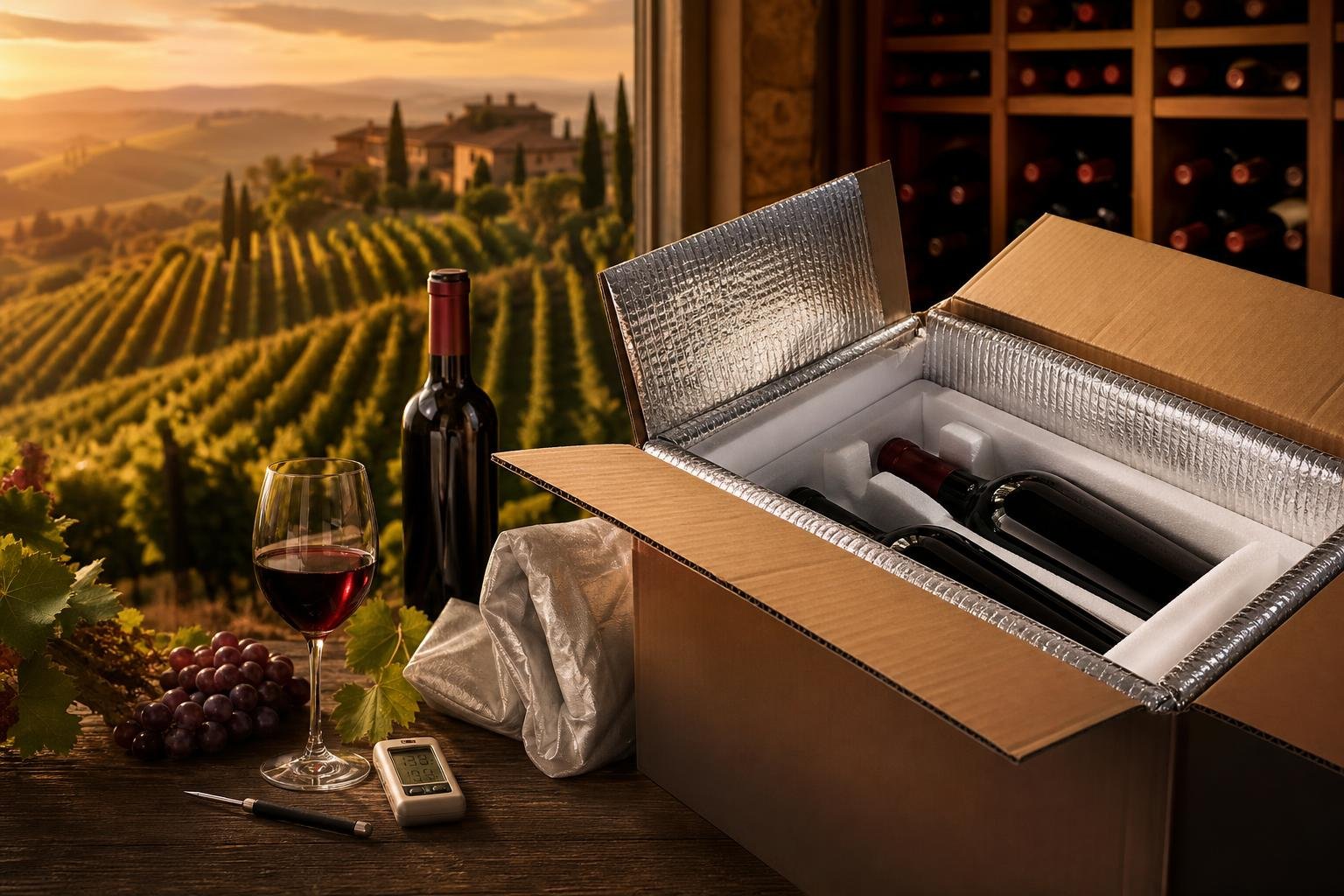
Wine is more resilient than its reputation sometimes suggests, but prolonged heat remains one of the greatest risks in transit. A bottle left in a delivery vehicle, loading bay, or sunny doorway can become considerably warmer than the surrounding air. Heat accelerates chemical reactions, encourages premature aging, and may cause the wine and trapped gases to expand. In severe cases, wine can seep past the closure, capsules may become sticky, and corks may rise in the neck.
There is no single temperature at which every wine is instantly damaged. Risk depends on the temperature reached, the duration of exposure, the closure, and the wine itself. A brief warm interval is not equivalent to days in a hot warehouse. Protection therefore begins with reducing both peak temperature and total exposure time.
Choose the Shipping Window Carefully
The most effective protection is avoiding extreme weather altogether. Before dispatch, check forecasts for the origin, destination, and major points along the route. Conditions at home tell only part of the story: a parcel traveling through an inland distribution center may encounter much higher temperatures.
When possible, ship early in the week. Monday or Tuesday dispatch reduces the chance that bottles will remain in a carrier facility over a weekend. Select the fastest practical service, particularly during late spring and summer. A less expensive service can become poor value if it adds several hot days to the journey.
Many specialist merchants offer a weather hold, keeping purchased wine in climate-controlled storage until temperatures moderate. This is often the safest choice for valuable, mature, or irreplaceable bottles. Confirm whether storage is temperature controlled and whether the merchant monitors weather along the full route rather than only at each endpoint.
The best hot-weather shipping strategy is not stronger packaging but less time in the heat.Use Insulation for the Right Purpose
Insulated shippers slow temperature change; they do not create refrigeration. Expanded polystyrene, molded fiber combined with reflective liners, and other insulated systems can buffer bottles against short heat spikes. Their effectiveness depends on insulation thickness, package design, outside temperature, and journey length.
Cold packs can provide additional protection, although ordinary frozen gel packs have limitations. They eventually warm, may create condensation, and can overcool the bottle if placed directly against the glass. Packs should be separated from bottles with cardboard or another insulating layer. Phase-change materials engineered to hold a chosen temperature range generally offer more controlled performance than household ice packs.
Dry ice is usually inappropriate for routine wine shipping. It is cold enough to freeze wine, can stress packaging, and releases carbon dioxide gas as it sublimates. Carrier rules also apply because dry ice is regulated in air transport. A professional temperature-controlled service is preferable when strict conditions are required.
Consider Refrigerated and Temperature-Controlled Transport
For fine wine, refrigerated transport offers the strongest protection during the long-distance portion of a journey. However, the phrase temperature controlled should be examined closely. It may describe only the main truck or warehouse, not every transfer and delivery van. Ask where temperature control begins and ends, what range is maintained, and how the final mile is handled.
A temperature indicator can reveal whether a package exceeded a specified threshold, while an electronic data logger records temperatures over time. Loggers are especially useful for high-value shipments, commercial consignments, and disputes because duration matters as much as the maximum reading. A single indicator cannot prove that a wine was damaged, but it can document potentially harmful handling.
Plan the Final Mile
The final delivery stage is frequently the weakest link. Arrange for an adult to be present, since alcohol shipments commonly require an adult signature under carrier policy and applicable law. Missed delivery attempts can send the parcel back into a warm vehicle or depot.
Where permitted, directing the package to a staffed carrier location or suitable business address may be safer than leaving it at a residence. Confirm that the collection point stores parcels indoors; not every facility is climate controlled. Delivery alerts help the recipient collect the shipment promptly. No wine should be left on a porch, in direct sunlight, or inside a parked car.
Pack Bottles Securely
Heat protection does not replace impact protection. Bottles should be separated in certified wine shippers so that glass cannot strike glass. Packaging must fit tightly enough to prevent movement while leaving room for insulation. Bottle orientation during a short journey is less important than secure packing and temperature management. Leakage protection, such as a sealed inner liner or absorbent material, can contain damage if a closure fails.
Check the destination rules before shipping. In many jurisdictions, consumers cannot legally send wine through ordinary postal or parcel channels, while licensed wineries and retailers must use approved services, labeling, and adult-signature procedures. Packaging a bottle well does not make an otherwise prohibited shipment lawful.
Inspect Wine After a Hot Delivery
If a parcel arrives noticeably warm, move it indoors and photograph the box, bottles, closures, and any temperature indicator before opening a bottle. Contact the seller promptly if there is seepage, a protruding cork, broken glass, or evidence of prolonged exposure. Keep the packaging until the claim is resolved.
Allow warm bottles to return gradually to an appropriate serving or cellar temperature. Avoid placing very hot glass directly into an ice bath. A raised cork or stained capsule is a warning sign, but it is not conclusive proof that the wine is spoiled. Conversely, a bottle can suffer accelerated aging without visible leakage.
Heat-affected wine may seem flat, prematurely mature, oxidized, or dominated by stewed-fruit and cooked aromas. Yet sensory evaluation is imperfect, and bottle variation complicates comparisons. The prudent approach is prevention: monitor weather, shorten the route, use effective insulation, arrange immediate receipt, and reserve refrigerated logistics for bottles whose value justifies the expense.