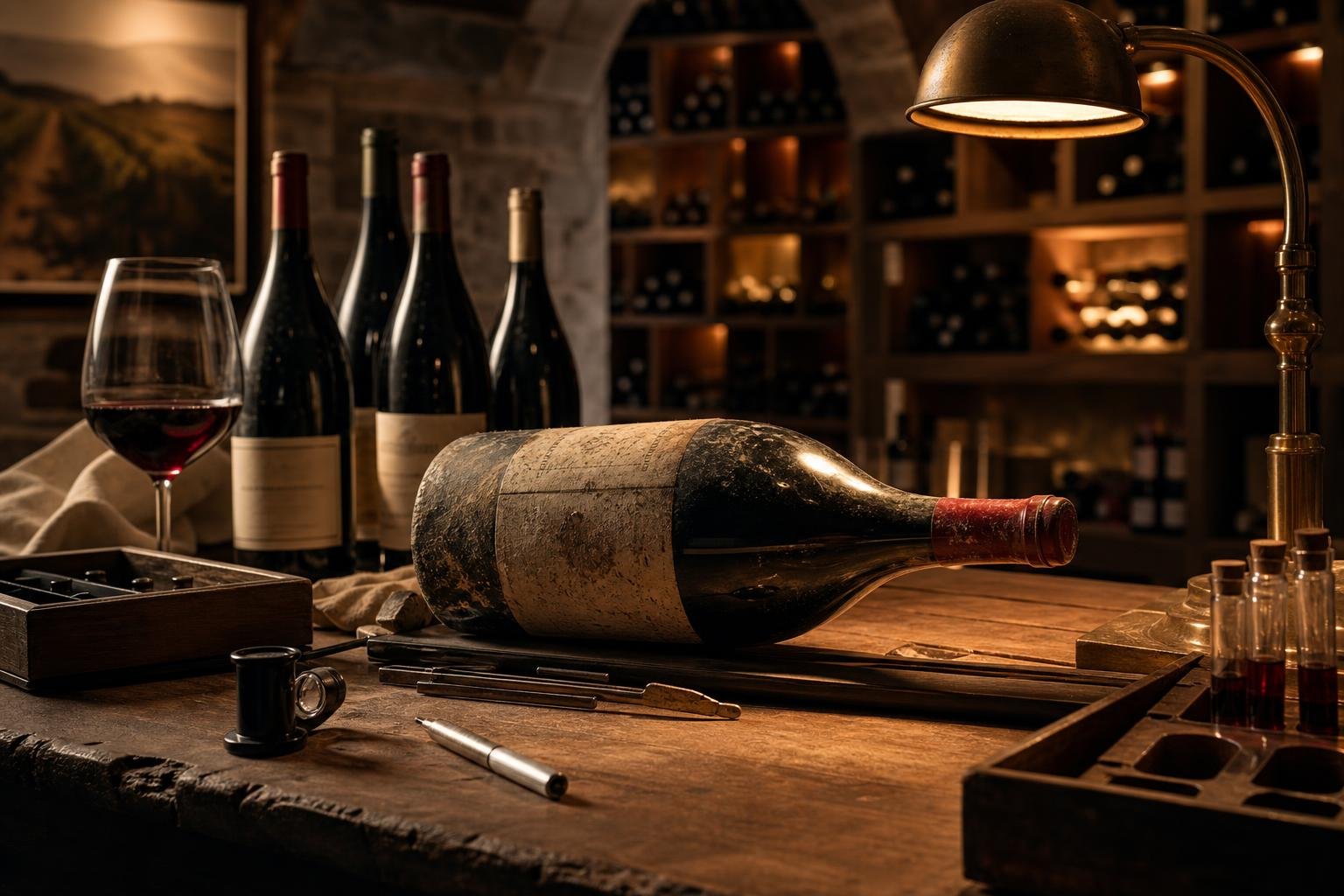
A celebrated label and an impressive layer of dust do not make a rare wine authentic. Counterfeiters may refill genuine bottles, reproduce labels, alter vintages or assemble convincing packages from period materials. Specialists therefore treat wine authentication as a cumulative investigation: the bottle, closure, paper, contents and ownership history must tell a coherent story.
Authentication Is a Chain of Evidence
No single feature proves that a bottle is genuine. An old cork can be inserted into the wrong bottle, while an authentic label can be transferred or modified. Experts compare many independent details with documented examples from the same producer, vintage and bottle format. The objective is not simply to find signs of age, but to identify inconsistencies that could not belong to the claimed period.
A rare bottle earns confidence when its history, materials and condition support the same conclusion.Provenance Comes First
Provenance is the documented history of ownership and storage. Auction invoices, merchant records, cellar inventories, insurance schedules and correspondence can help establish where a wine has been. A continuous trail from release is particularly valuable, although paperwork itself must be verified. Experts check whether merchants existed at the stated time, whether shipping dates are plausible and whether a producer actually bottled that wine in the claimed size or market format.
Storage history also matters. A bottle said to have spent decades in a cool cellar should not display heat damage, a pushed cork or unexpectedly severe ullage. Conversely, perfect cosmetic condition is not automatic proof of fraud: professionally maintained collections can remain remarkably clean.
The Bottle Is a Historical Object
Glass offers numerous clues. Inspectors study bottle shape, weight, color, mold seams, punt, embossing and manufacturing marks. These features are compared with known bottles because glass production changed over time and varied among suppliers. A container may be genuinely old yet still be wrong for the château, vintage or export market shown on its label.
Experts remain cautious with broad rules. Producers sometimes used several glass suppliers, and bottles could vary within a single vintage. Chemical analysis of glass may provide supporting information, but recycled raw materials and manufacturing variation usually prevent glass composition from acting as a simple date stamp.
Labels Reveal Printing Anachronisms
Labels are examined under magnification and different wavelengths of light. Specialists assess paper fibers, ink, printing method, typography, alignment, die-cut edges, staining and adhesive. Modern reproduction techniques can leave dots, toner or unnaturally sharp details inconsistent with historical letterpress or lithographic printing.
Ultraviolet light may reveal optical brighteners found in some modern papers, but fluorescence is only a screening clue. Paper stocks differed, and old labels can be cleaned, restored or reattached. Experts also compare tiny design details with reliable reference bottles: punctuation, accent marks, borders, vineyard names and stated alcohol levels can expose a careless forgery.
Corks, Capsules and Fill Levels
The closure is another important record. Through the glass, an examiner may assess cork length, staining, branding and apparent age. Capsules are checked for period-appropriate material, color, crimping, printing and signs of removal. Lead, tin and aluminum capsules appeared in different contexts, so conclusions must be producer-specific rather than based on material alone.
Fill level, or ullage, can indicate how a bottle has aged and been stored. Some evaporation is normal, especially in very old wine, but an implausibly high fill may suggest recent refilling. A low level can reflect natural aging, cork failure or poor storage; it is evidence of condition, not proof of authenticity.
What Laboratory Science Can Establish
When a bottle is valuable enough, scientific testing can supplement visual examination. Gamma-ray spectrometry can detect cesium-137, a radioactive isotope dispersed widely by atmospheric nuclear testing from the early 1950s onward. Its detection can show that wine is not from an earlier era, sometimes without opening the bottle. Its absence, however, does not conclusively prove a pre-nuclear date because concentrations vary and may fall below detection limits.
Tests involving carbon-14, stable isotopes or elemental composition may help constrain age or geographic origin, but many require a sample and careful interpretation. Imaging techniques can inspect closures or internal features non-destructively. No laboratory result substitutes for provenance, and results are strongest when compared with authenticated reference material.
Why Tasting Is Not Enough
A skilled taster may recognize that a supposed mature Burgundy resembles young Pinot Noir, yet sensory judgment alone cannot identify a vintage reliably. Counterfeit blends can imitate age, sweetness, acidity and color, while genuine bottles vary because of storage and bottle development. Opening the wine also destroys much of its collectible value, making tasting a late-stage assessment rather than the first test.
Lessons from Major Wine Frauds
The Rudy Kurniawan case demonstrated how convincing counterfeits can combine genuine empty bottles with fabricated labels, corks and blended wines. He was convicted in the United States in 2013. The scandal encouraged auction houses, collectors and producers to strengthen inspection, maintain photographic records and scrutinize provenance rather than relying on reputation or a persuasive story.
Practical Advice for Collectors
Buy from established specialists who provide condition reports, provenance information and clear return terms. Request high-resolution photographs of the label, capsule, cork area, fill level, base and glass markings. Compare the bottle with documented examples, and be suspicious of unsupported discoveries, improbable quantities or prices detached from the market. Authentication rarely delivers absolute certainty, but disciplined evidence can reduce risk substantially.